Grow your content discovery and overcome zero-click search
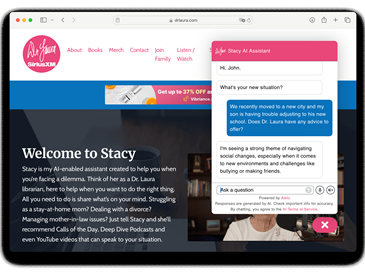
Alelo’s AI-powered Content Navigators help listeners discover content relevant to their personal needs and interests, and encourage listening instead of zero-click search. Our AI assistants maximize audience engagement by uncovering recordings that search engines often overlook, generating continuing revenue and engagement. Our AI works for creators, not against them.
Watch Video

Learn durable skills in half the time
In cloud-based generative AI sessions, learners engage in challenging conversations with socially intelligent avatars in realistic scenarios. Immediate feedback provides personal instruction on how to improve. Learners interact with avatars as often as they like. Independent studies have shown that learning is at least twice as fast as with conventional approaches, and learners confidently apply their skills on the job.
Watch VideoFOR HEALTH SYSTEMS
TRUSTWORTHY AI EDUCATES PATIENTS AND GUARDS AGAINST HEALTH MISINFORMATION
AI-powered Resource Navigators educate patients and their families and guard against online health misinformation. Instead of searching through complex health information websites or YouTube, users can simply describe their situation and the Navigator will recommend content that is most relevant to them. Resource Navigators reduce the burden on care teams by answering common questions. They direct users to approved content and avoid misinformation sources on social media. Alelo Resource Navigators are designed to be trustworthy and are tested for regulatory compliance. Alelo solutions have been recognized by AVIA Marketplace as Top Reviewed in Conversational AI and Patient Education. Read more>

FOR CORPORATIONS
LET DATA LEAD YOUR HUMAN CAPITAL DIGITAL TRANSFORMATION
Assess and skill simultaneously using generative AI, all while gathering crucial data to act on.
ASSESS
Measure individual learner performance and collectively reveal group progress or skills gaps with data collected from learner interactions during AI simulations.

SKILL
Improve learning agility and skills transfer through sound “learn by doing” and “learn by teaching” pedagogy led by data-driven conversational AI interactions.

ACT
Fine-tune training, identify new learning opportunities, and confidently demonstrate the impact of learning on organizational goals with collective simulation data.

Explore Products
For Individuals
Alelo MyCoach™ Soft Skills with generative AI
- Stand out in job interviews
- Better position yourself for promotions
- Build stronger relationships with colleagues
- Navigate complex situations more easily
A whopping 92% of hiring professionals feel that soft skills matter as much or more than hard skills according to LinkedIn’s Global Talent Trends 2019. Now individuals can practice coveted soft skills like problem-solving, listening, and emotional intelligence with GenAI avatars in authentic scenarios.
LEARN MOREFor Rapid Skilling
ALELO ENSKILL® HR WITH GENERATIVE AI
- Upskill or reskill employees 2X faster
- Attract and retain workers with better training and career advancement opportunities
- Quickly close the skills gap in your organization
Interacting with GenAI avatars in authentic workplace scenarios gives workers experience applying new skills. It is as close as workers can get to real on-the-job training, but in a controlled setting where outcomes are assessed, measured, and improved.
LEARN MOREFor Student Education
ALELO ENSKILL® ED WITH CONVERSATIONAL AI
- Accelerate student learning and improve engagement
- Reduce teacher workloads while making their work more rewarding
- Lower costs for remote and hybrid learning
Students learn through online interactions with avatars. Performance can be tracked at the institution, class, or student level, making it easy to identify students falling behind. Enskill Ed custom products are effective in small or large classes and can be scaled with minimum cost.
LEARN MOREFor Government Personnel Training
ALELO CUSTOM PRODUCTS FOR GOVERNMENT
- Faster, more effective culture and language training for overseas deployments
- Available on government servers
- Supports laptops, mobile devices, and VR displays
Alelo is mandatory culture and language training for U.S. personnel deploying overseas to 86 countries. Using avatar-based training, learners improve their communications skills with local populations faster, more effectively, and at lower costs than conventional training. Watch an Air Force success story video.
SCHEDULE A DEMOProducts
ALELO MYCOACH™ SOFT SKILLS
WITH GENERATIVE AI
- Stand out in job interviews
- Better position yourself for promotions
- Build stronger relationships with colleagues
- Navigate complex situations more easily
A whopping 92% of hiring professionals feel that soft skills matter as much or more than hard skills according to LinkedIn’s Global Talent Trends 2019. Now individuals can practice coveted soft skills like problem-solving, listening, and emotional intelligence with GenAI avatars in authentic scenarios.
LEARN MOREAlelo Enskill® HR
WITH GENERATIVE AI
- Upskill or reskill employees 2X faster
- Attract and retain workers with better training and career advancement opportunities
- Quickly close the skills gap in your organization
Interacting with GenAI avatars in authentic workplace scenarios gives workers experience applying new skills. It is as close as workers can get to real on-the-job training, but in a controlled setting where outcomes are assessed, measured, and improved.
LEARN MOREAlelo Enskill® ED
WITH CONVERSATIONAL AI
- Accelerate student learning and improve engagement
- Reduce teacher workloads while making their work more rewarding
- Lower costs for remote and hybrid learning
Students learn through online interactions with avatars. Performance can be tracked at the institution, class, or student level, making it easy to identify students falling behind. Enskill Ed custom products are effective in small or large classes and can be scaled with minimum cost.
LEARN MOREALELO CUSTOM PRODUCTS
FOR GOVERNMENT
- Faster, more effective culture and language training for overseas deployments
- Available on government servers
- Supports laptops, mobile devices, and VR displays
Alelo is mandatory culture and language training for U.S. personnel deploying overseas to 86 countries. Using avatar-based training, learners improve their communications skills with local populations faster, more effectively, and at lower costs than conventional training. Watch an Air Force success story video.
Get a DemoUsed by leading organizations across the globe


BRING PERSONALIZATION TO EXPERIENTIAL LEARNING
Generative and conversational AI power the personalized feedback and on-the-spot instruction learners need during immersive or experiential learning. Forward-thinking organizations rely on Alelo to develop critical thinking competencies that stick and adapt.


VCATs are an outstanding training resource for the Department of Defense. Alelo’s work on the VCATs has always been of the highest standard.
Cathleen Moran, Program Manager, Joint Knowledge OnlineWe chose Alelo to work with us because they offer both a leading-edge approach and a proven track record.
Gordon Lewis, Vice President, Laureate Language ServicesIf you want your students to have more self-confidence, Alelo is going to be your best option. The students love it.
Erendira Yadira Carrera García, Program Director, UVM Toluca Campus

Alelo Top Reviewed
AVIA Marketplace recognizes Alelo as one of the Top Reviewed Vendors in Conversational AI and Patient Education with a score of 4.9 out of 5!
Awards & Accolades


ALELO MAKES AN IMPACT
Wer stellt legal Online Casino Lizenzen aus? – Malta Gaming Authority (MGA). Seit 2001 vergibt die MGA seriöse Glücksspiellizenzen, die in der gesamten EU gültig sind. Erleben Sie die Spannung von Online-Casinos auf der Bewertungsseite online-austria.at! Entdecken Sie die besten Angebote mit einer großen Auswahl an Spielen!
Wages are expected to increase by $8.7M for America’s most vulnerable workers thanks to innovation in training from Alelo and other XPRIZE Rapid Reskilling finalists. Read more >
Casino mit Magenta einzahlung Österreich markiert einen aufregenden Schritt in Richtung einer bequemeren und effizienteren Welt des Online-Glücksspiels. Die Kombination aus Schnelligkeit, Sicherheit und finanzieller Kontrolle macht diese Zahlungsmethode zu einer vielversprechenden Option für Spieler. Es ist jedoch ratsam, die spezifischen Bedingungen der Casinos zu überprüfen und sicherzustellen, dass Casino mit Magenta Österreich den individuellen Bedürfnissen gerecht wird.
Wie funktioniert es?
Die Nutzung von Magenta als Zahlungsmethode in Online-Casinos ist denkbar einfach. Hier sind die Schritte, die die Spieler befolgen können:
1. Auswahl der Magenta-Zahlungsoption: Während des Einzahlungsvorgangs im Casino wählt der Spieler die Option mit Magenta bezahlen.
2. Eingabe des Einzahlungsbetrags: Der gewünschte Einzahlungsbetrag wird eingegeben, und die Transaktion wird bestätigt.
3. Zahlung über die Magenta-Rechnung: Der Betrag wird dann zur monatlichen Magenta-Rechnung hinzugefügt oder vom Prepaid-Guthaben abgezogen.
Latest News

Alelo Enskill® …lets you practice authentic communication with artificially intelligent on-screen characters.

Alelo is pioneering new avenues of personalized education.
by Dr. W. Lewis Johnson and Geoffrey Rich In a recent provocative blog post, Steven Goldstein, an internationally recognized executive and leader in scaling and...

by Dr. W. Lewis Johnson and Geoffrey Rich As Shelly Palmer noted in a recent blog post, conventional search traffic is down 30-45%, and is...

On January 8, 2025, Training Magazine Network hosted a webinar by Dr. Lewis Johnson entitled “Using AI to Train and Assess Soft Skills: Examples from...